Two pashminas can start from the same soft base and end up looking completely different depending on how they are decorated. Understanding the main methods behind custom printed pashminas and their woven and embroidered cousins is the difference between a wrap that matches your vision exactly and one that arrives close-but-not-quite. Each technique has a distinct look, a different price, and its own strengths and limits, and the right choice depends on your design, your budget, and how you want the finished wrap to feel in the hand.
This guide walks through the decoration methods used for custom printed pashminas, woven designs, and embroidery, so you can pick the technique that brings your pattern, logo, or monogram to life without surprises.
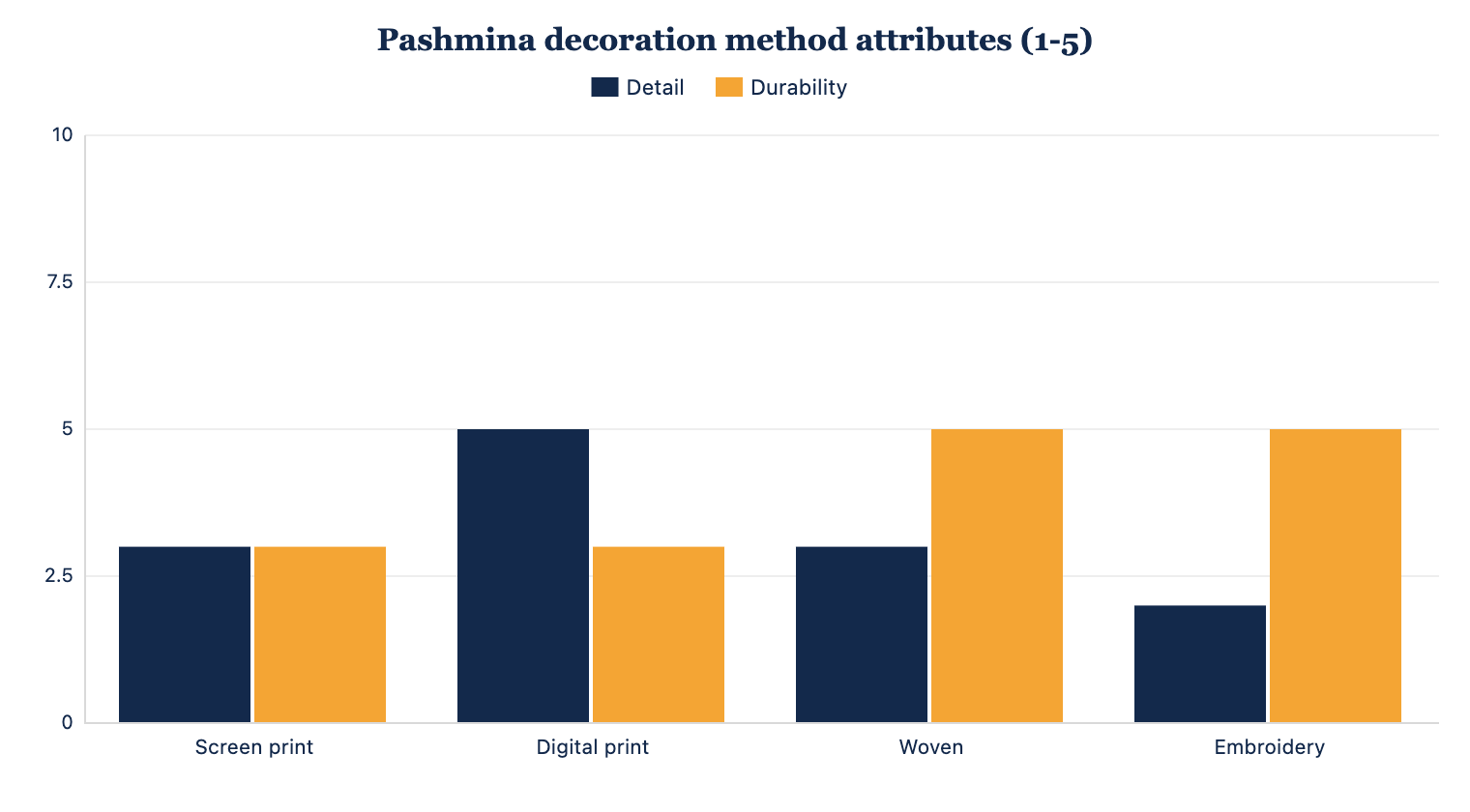
Printing is the most flexible way to decorate a pashmina, and it splits into two main approaches. Screen printing pushes ink through a stencil, one color at a time, which gives rich, opaque color and is cost-effective for simple designs with a few flat colors, though each color adds to setup. Digital or sublimation printing, by contrast, can reproduce photographs, gradients, and intricate multi-color patterns with no per-color penalty, making it the go-to for detailed all-over designs. Printed pashminas keep a soft hand because the design sits in the fibers rather than on top of them, especially with sublimation on poly-blend bases.
Woven decoration is the most premium and durable route because the pattern is not applied at all, it is part of the fabric itself. Jacquard weaving creates the design as the cloth is made, so it can never peel, crack, or wash out, and it gives a subtle, tactile, tone-on-tone elegance that printing cannot match. The trade-offs are cost and lead time: weaving requires more setup and suits larger orders and simpler, geometric or logo-based motifs rather than photographic detail. For a heritage brand or a luxury keepsake, nothing feels quite as considered as a woven wrap.
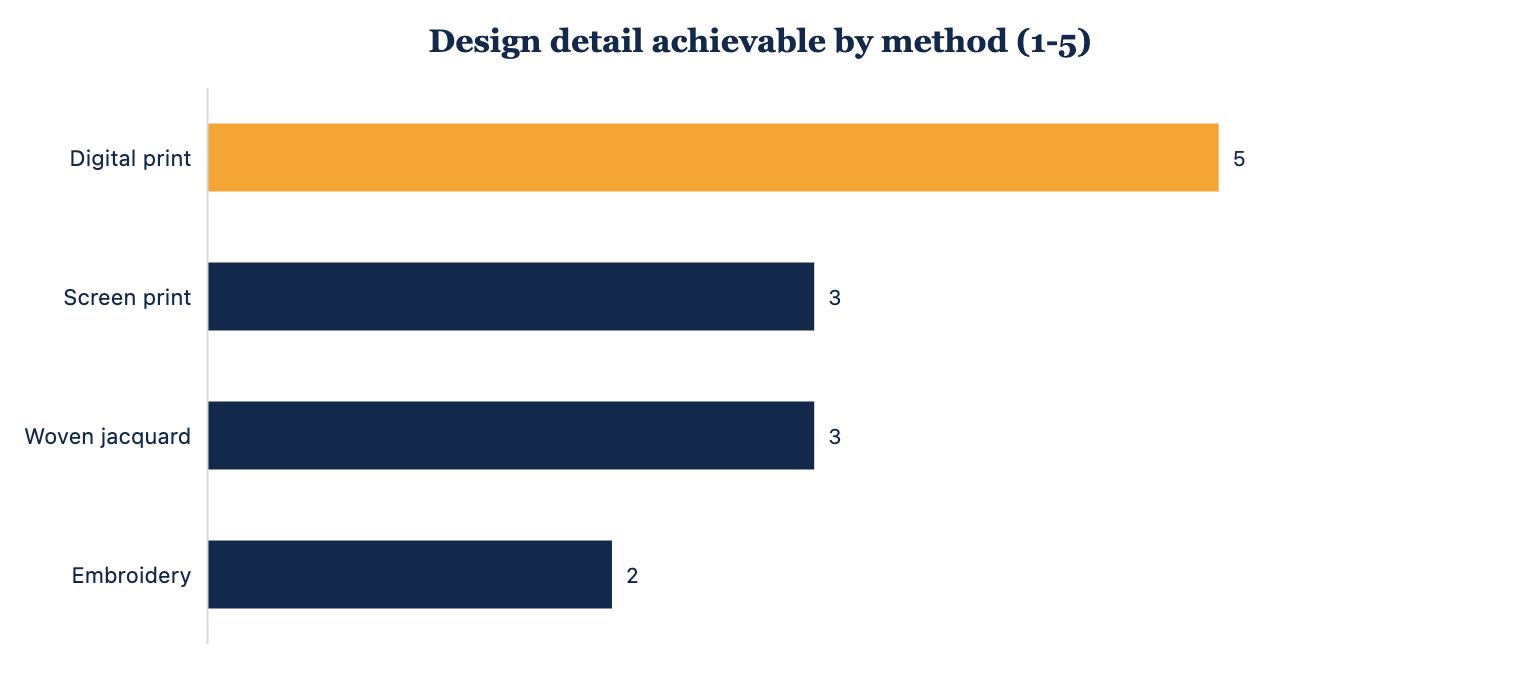
Embroidery stitches thread directly into the fabric, creating a raised, textured mark that reads as quality the instant someone touches it. It is ideal for monograms, small logos, names, and dates, exactly the kind of tasteful personalization that suits wedding favors and corporate gifts. Embroidery is extremely durable and looks expensive, but it is not suited to large or highly detailed images, and dense stitching can stiffen a lightweight wrap if overdone. A small embroidered corner motif is often the most elegant personalization available.
| Method | Best for | Detail | Durability |
|---|---|---|---|
| Screen print | Bold, few-color designs | Medium | Good |
| Digital / sublimation | Photos, gradients, all-over | Excellent | Good |
| Woven (jacquard) | Logos, tone-on-tone patterns | Medium | Excellent |
| Embroidery | Monograms, names, small logos | Low-medium | Excellent |
The right technique follows from your design and your goal. Want a full-color photographic or intricate pattern? Digital printing is the only method that handles it cleanly. Need a bold two-color logo on a budget for a big run? Screen printing is efficient. After a subtle, luxury, forever-durable finish for a heritage or corporate keepsake? Weaving earns its premium. Just adding names or a monogram to an otherwise plain wrap? Embroidery gives the most tactile, upscale result. Many projects combine a plain woven base with a small embroidered monogram for the best of both.
Decoration interacts with the base. Fine viscose and modal bases take print beautifully and drape softly; wool and wool-blend bases suit weaving and embroidery and feel warmer. Sublimation printing needs a synthetic or high-poly base to bond properly, so if your heart is set on a specific fiber, confirm it is compatible with your chosen method before you commit. A quick conversation about base and method together prevents the most common disappointment.
Each technique carries its own cost structure, and understanding it helps you plan a realistic budget. Screen printing has a setup cost per color but a low per-unit price, so it rewards larger runs of simple designs. Digital printing has little setup, which makes it friendly for smaller quantities and complex art, though the per-unit cost holds steadier as volume grows. Weaving carries the highest setup and the longest minimums, since a loom has to be programmed, so it makes sense mainly for sizable orders. Embroidery is priced by stitch count, so a small monogram stays affordable while a dense, large design climbs quickly. Knowing these structures up front prevents a design choice that quietly blows the budget.
Whatever method you choose, ask for a proof or a physical sample before the full run. Screen and digital colors can shift between a screen mockup and dyed cloth; a woven pattern reads differently at scale than in a drawing; embroidery density feels different in the hand than on paper. A single sample catches problems while they are still cheap to fix, and it lets you confirm the hand-feel of the finished wrap, not just its appearance. Reputable suppliers expect this step and build it into the timeline.
Different finishes want different care. Printed wraps generally prefer gentle, cool washing to keep colors vivid; woven designs are the most forgiving because the pattern is structural; embroidery lasts well but appreciates being turned inside out or washed in a bag to protect the stitches. Passing simple care guidance to gift recipients helps your wraps look good for years, which is the whole point of choosing a durable method in the first place.
Whether you choose custom printed pashminas, woven jacquard, or embroidery comes down to your design and how permanent and premium you want the result. Print for color and detail, weave for durable tone-on-tone luxury, embroider for a tactile monogram, and always match the method to a compatible base fabric. Get that pairing right and your wraps look exactly as you imagined.
Send us your artwork or monogram and we will recommend the decoration method and base fabric that fit, then quote it.
Get a QuoteHome · About · Buying guides · Companion guide: pashmina wedding favors
Enter below for a chance to win plus receive 10% off your first order.
Check your email for your 10% off code. Good luck!
 Call or Text us: (929) 605-4397